

A new HVAC system can be high-efficiency equipment and still leave a home uncomfortable if the system around it is designed or installed incorrectly.
That is why choosing HVAC equipment by brand, efficiency rating or price alone is risky.
ACCA's HVAC Quality Installation standards identify system design, equipment installation, distribution and final documentation as core elements of a quality installation. ENERGY STAR similarly emphasizes correct sizing, airflow and refrigerant charge rather than treating installation as simply connecting new equipment and turning it on. [41]
For Oklahoma homeowners, understanding the most common installation mistakes can help in two situations:
before signing a replacement proposal,
and when a relatively new system has never performed the way it should.
Here are the problems worth understanding.
Mistake: Choosing Equipment Size by Square Footage Alone
One of the most important installation decisions occurs before the equipment arrives.
The sizing section in why load calculations matter explains why the old nameplate and square footage alone are weak selection methods.
How large should the system be?
A common shortcut is to select capacity from square footage or replace the old unit with exactly the same size.
Neither approach proves that the size is correct.
Two homes with the same floor area can have different loads because of insulation, window area, building orientation, air leakage, ceiling height and other characteristics.
ACCA's Manual J is the recognized residential load-calculation method, while ENERGY STAR specifically advises contractors to use the home's actual characteristics instead of a rule of thumb when sizing HVAC equipment. [42]
Why oversizing causes problems
An oversized system may satisfy the thermostat quickly and shut off, then restart soon afterward. ENERGY STAR notes that oversized equipment can cycle too frequently, reducing comfort and potentially shortening equipment life.
Why undersizing causes problems
An undersized system may struggle to satisfy the home's load during demanding conditions.
But a system that runs for long periods is not automatically undersized. Properly sized modern equipment can have long operating cycles at peak load, particularly staged or variable-capacity systems.
Sizing should therefore be verified through calculation, not guessed from runtime alone.
Mistake: Ignoring the Existing Duct System
Replacing the equipment does not replace the ductwork.
A new air conditioner, heat pump or furnace still has to move conditioned air through the distribution system already in the house.
If ducts are poorly sized, highly restrictive, disconnected, excessively leaky or otherwise unable to move the airflow the new equipment requires, the homeowner may experience:
weak airflow,
hot and cold rooms,
excessive equipment noise,
long run times,
or poor overall comfort.
ENERGY STAR's quality-installation guidance says ducts should be evaluated and system airflow should be adjusted to meet equipment performance requirements. ACCA's installation framework likewise treats air distribution as a core part of system quality.
That means a replacement quote should not treat the duct system as invisible.
Ask whether the existing distribution system is appropriate for the new equipment.
Mistake: Installing a High-Efficiency System Without Verifying Airflow
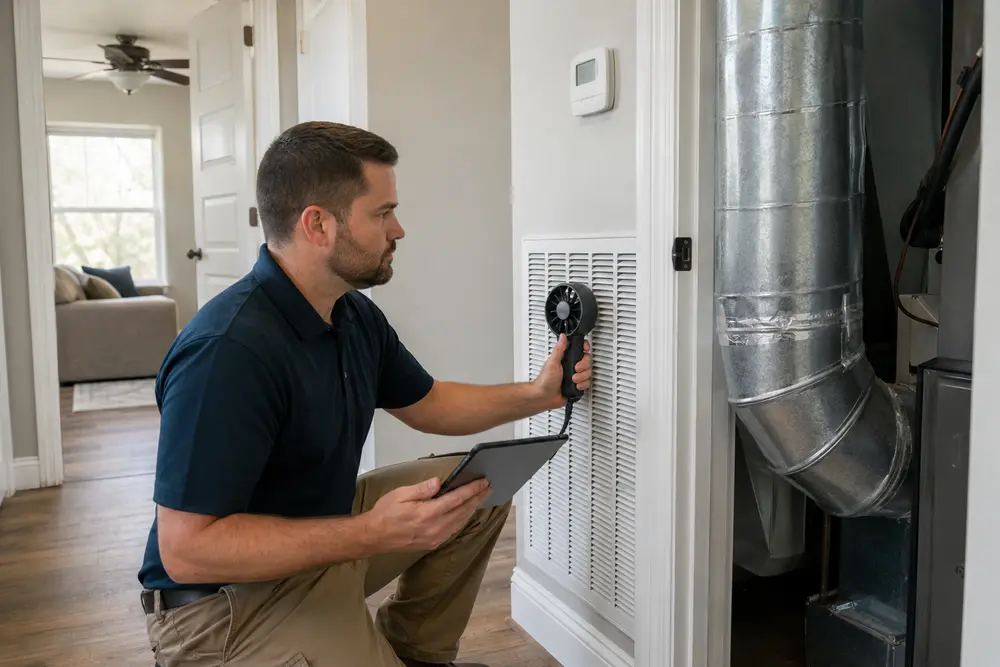
Airflow is not just about whether air comes out of the vents.
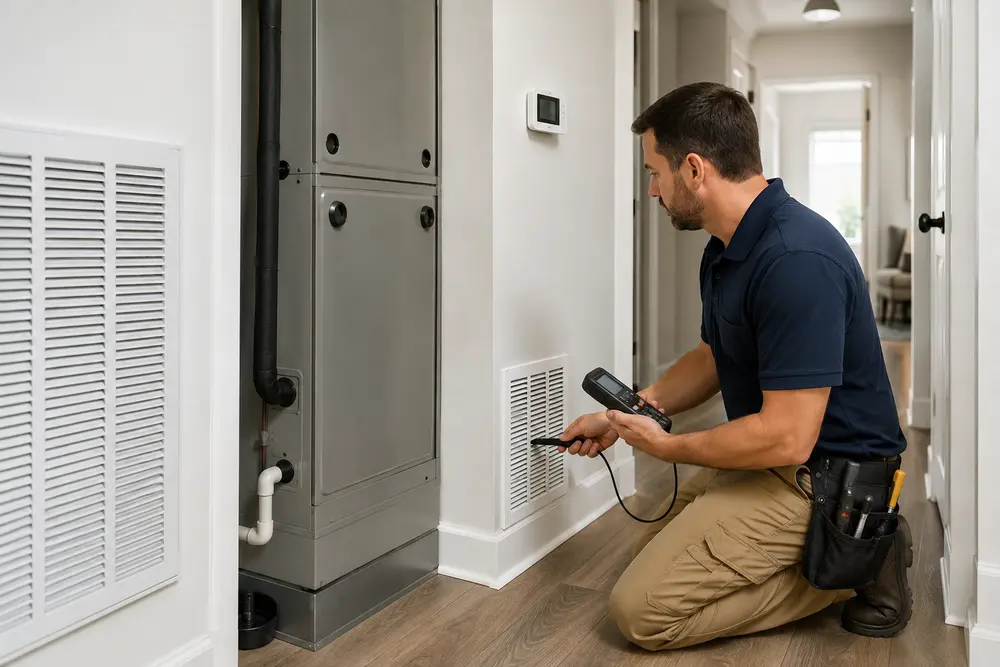
The HVAC equipment is designed to operate within specified airflow conditions.
ENERGY STAR warns that poor airflow can reduce efficiency, increase energy use, affect comfort and shorten equipment life. Its quality-installation guidance specifically recommends verifying that airflow meets the manufacturer's performance specifications.
Problems can originate from more than one place:
duct restrictions,
incorrect blower settings,
dirty or restrictive filters,
coil selection,
poor return-air design,
or installation setup.
This is why "it turns on" is not enough to prove a new system was commissioned properly.
Mistake: Getting Refrigerant Charge Wrong
For an air conditioner or heat pump, refrigerant charge is another critical installation variable.
Homeowners replacing cooling equipment can compare the complete scope of available AC installation options, including setup and verification.
Too much or too little refrigerant can prevent the system from operating as designed.
ENERGY STAR's quality-installation guidance explicitly identifies proper refrigerant charge as necessary for optimal efficiency, comfort and system reliability.
Refrigerant work is not a homeowner troubleshooting task.
The installer should follow the manufacturer's charging procedure for the equipment and installation conditions and verify system performance with appropriate instruments.
A homeowner does not need to know how to calculate superheat or subcooling to ask a good question.
Simply ask:
"How will you verify the refrigerant charge after installation?"
A credible installer should be able to explain the process.
Mistake: Assuming the Existing Thermostat Location Is Automatically Correct
The thermostat determines when the system runs based on what it senses.
If it is installed in direct sunlight, near a heat-producing device, behind furniture, in a draft or another unrepresentative location, the HVAC equipment may react to conditions that do not match the rest of the house.
Resideo specifically recommends thermostat placement where air movement is representative of the controlled space and advises avoiding direct sunlight, major heat sources and obstructed locations. [24]
A new HVAC installation is a good time to reconsider an old thermostat location instead of automatically putting every new control on the same wall.
The same applies to remote room sensors and zoning controls.
Mistake: Treating Furnace Installation as Only an Equipment Swap
Gas-furnace installation involves more than capacity and ductwork.
For combustion equipment, the furnace installation options should define venting, controls, airflow and startup responsibilities.
Combustion air, venting, gas connections, ignition and safety controls all have to function correctly.
ACCA's Quality Installation specification applies to furnaces as well as air conditioners and heat pumps and includes system-design, installation and distribution considerations. [44]
For homeowners, the practical lesson is simple:
Do not judge a furnace installation only by whether the equipment produces warm air on installation day.
Final testing needs to confirm safe and correct operation.
Mistake: Skipping Final Commissioning
Commissioning is the process of checking that the installed HVAC system actually performs as intended after installation.
The same commissioning principle applies when reviewing heat-pump installation options and cold-weather control strategies.
ACCA's Standard 310 framework includes items such as design review, duct leakage evaluation, airflow measurement, blower performance and refrigerant-charge evaluation for applicable unitary systems. [45]
The exact tests appropriate to your project depend on the system.
But the core idea is universal:
The installer should measure and verify performance rather than assume it is correct because the equipment turns on.
A useful final handoff should address items such as:
thermostat operation,
airflow,
equipment staging where applicable,
refrigerant-system operation where applicable,
heating operation,
drainage,
and homeowner control settings.
Mistake: Failing to Explain the System to the Homeowner
Quality installation does not end when the tools leave the driveway.
ACCA includes system documentation and owner education among the broad components of quality installation. [44]
A homeowner should know at least:
what filter the system uses,
where the filter is located,
how the thermostat is intended to operate,
whether the equipment has multiple stages or variable capacity,
what normal operating sounds and cycles look like,
how to recognize a condensate or drainage problem,
and what maintenance schedule is recommended for that particular equipment.
This is especially important with heat pumps and dual-fuel systems because their operating patterns can be different from the furnace-and-AC setup a homeowner may be accustomed to.
Warning Signs a New HVAC System May Need a Second Look
A single symptom does not prove poor installation, but repeated problems shortly after replacement deserve investigation.
Pay attention when:
the home has never reached comfortable temperatures since installation,
rooms became more uneven after the replacement,
the equipment starts and stops unusually frequently,
airflow is substantially weaker or noisier than before,
a heat pump or AC repeatedly develops an operational problem,
water collects around the indoor equipment,
the thermostat reading consistently fails to represent the living space,
or the system has required repeated corrections since installation.
Some of these conditions may have causes unrelated to the installation itself. The point is to investigate rather than assuming that new equipment cannot be responsible.
Questions Oklahoma Homeowners Should Ask Before an HVAC Replacement
You do not have to become an HVAC technician to evaluate an installation proposal.
A complete proposal should connect these quality checks to the actual HVAC replacement options; homeowners can then request a system evaluation based on a defined scope.
Ask a few high-value questions.
How did you determine the required equipment size?
Look for an answer involving actual load evaluation, not simply square footage.
Will you evaluate my existing ductwork?
New equipment still depends on the existing distribution system.
How will airflow be verified?
The installer should have a plan beyond checking whether air comes out of a register.
How will AC or heat-pump refrigerant charge be verified?
The answer should involve manufacturer procedures and measurements.
How will the completed system be tested?
You want commissioning, not merely startup.
Will you explain the thermostat, filters and normal operation before you leave?
Homeowner education is part of a complete installation process.
These questions align closely with the installation-quality concepts emphasized by ACCA and ENERGY STAR. [46]
Installation Quality Matters as Much as Equipment Selection
It is easy to spend weeks comparing brands, SEER2 ratings, furnace stages and heat-pump features while giving only a few minutes of attention to installation.
That is backwards.
A premium system still depends on correct design, sizing, airflow, distribution, refrigerant setup where applicable, controls and commissioning.
ACCA notes that quality installation encompasses design, equipment installation, distribution and documentation rather than the equipment alone. [44]
If you are replacing equipment, compare the installation process as carefully as you compare the equipment itself.
Get Clear Guidance for Your Home
If you are planning an HVAC replacement, ask how the system will be sized, how the existing ductwork will be evaluated, and how performance will be verified after installation. A good equipment decision should come with an equally strong installation plan.
Frequently Asked Questions
What is the most common HVAC installation mistake?
Incorrect sizing is one of the highest-impact problems because every other part of the installation is built around the selected equipment. ENERGY STAR specifically warns against rule-of-thumb sizing and recommends using actual home characteristics. [12]
How can I tell if my new HVAC system is oversized?
Frequent short operating cycles can be a warning sign, although they can have other causes. ENERGY STAR notes that oversized equipment may cycle too frequently and reduce comfort. A load calculation and system evaluation are more reliable than diagnosing size from one symptom alone.
Can bad ductwork make a new HVAC system perform poorly?
Yes. Poor duct performance and inadequate airflow can reduce comfort and prevent the equipment from operating as intended. Quality-installation guidance includes duct evaluation and airflow verification for this reason.
Should a contractor perform a Manual J calculation before replacing HVAC equipment?
A residential load calculation is the proper basis for determining the home's heating and cooling needs. ACCA's Manual J is the recognized residential methodology, particularly when there is reason to question the size of existing equipment or the house has changed. [18]
What should happen after a new HVAC system is installed?
The system should be commissioned and its relevant performance characteristics verified. Depending on equipment, this can include airflow, controls, duct performance, blower operation, refrigerant charge and heating operation. ACCA's installation-verification standards formalize several of these measurements. [49]