
When the thermostat says 76°F even though you set it to 72°F, the thermostat is not necessarily the problem.
A home that will not reach the set temperature can be caused by the thermostat itself, restricted airflow, an HVAC equipment problem, duct issues, unusually high heating or cooling load, incorrect system sizing, or even a thermostat schedule that is doing exactly what it was programmed to do.
The best first step is to separate two questions:
Is the thermostat reading or communicating incorrectly?
Or:
Is the thermostat correctly calling for heating or cooling, but the HVAC system cannot satisfy that call?
That distinction can save a lot of unnecessary thermostat replacement.
Start by Checking What the Thermostat Is Actually Asking the System to Do
Before diagnosing the air conditioner or furnace, verify the basic settings.
Confirm that the thermostat is in the correct operating mode: COOL during cooling season or HEAT during heating season.
Next, check the requested temperature and review any schedule, hold, Eco, recovery or energy-saving feature that could be changing the setpoint.
Smart thermostats may intentionally alter when heating or cooling starts as part of their programmed features. For example, ecobee documents a Smart Recovery function that can start equipment in advance so the home reaches the scheduled temperature at the desired time. Google Nest thermostats also use scheduled and learned temperature settings depending on the thermostat model and configuration. [23]
A system that appears to be ignoring you may therefore be following another active setting.
Check Whether the Thermostat's Temperature Reading Makes Sense
Your thermostat controls the HVAC system based on the temperature it senses around the thermostat.
Location matters.
Resideo advises locating thermostats where surrounding airflow is representative of the conditioned space and avoiding direct sunlight, heat-producing appliances, major heat sources and locations blocked by curtains or furniture. [24]
Think about the thermostat's surroundings.
Is afternoon sunlight hitting it?
Is it near an exterior door?
Is a supply vent blowing directly toward it?
Is it close to a kitchen, television or another source of heat?
If the thermostat is sensing a microclimate that does not represent the rest of the house, it can operate the HVAC system correctly based on the wrong information.
Do not immediately change calibration or installer settings. First compare what you feel around the house with what the thermostat reports and consult the thermostat manufacturer's instructions for that specific model.
A Dirty Filter Can Look Like a Thermostat Problem
Suppose the thermostat is calling for cooling and the outdoor unit is running, but very little air is coming from the registers.
If the filter looks questionable, start by checking how often your HVAC filter should be changed for the system and household.
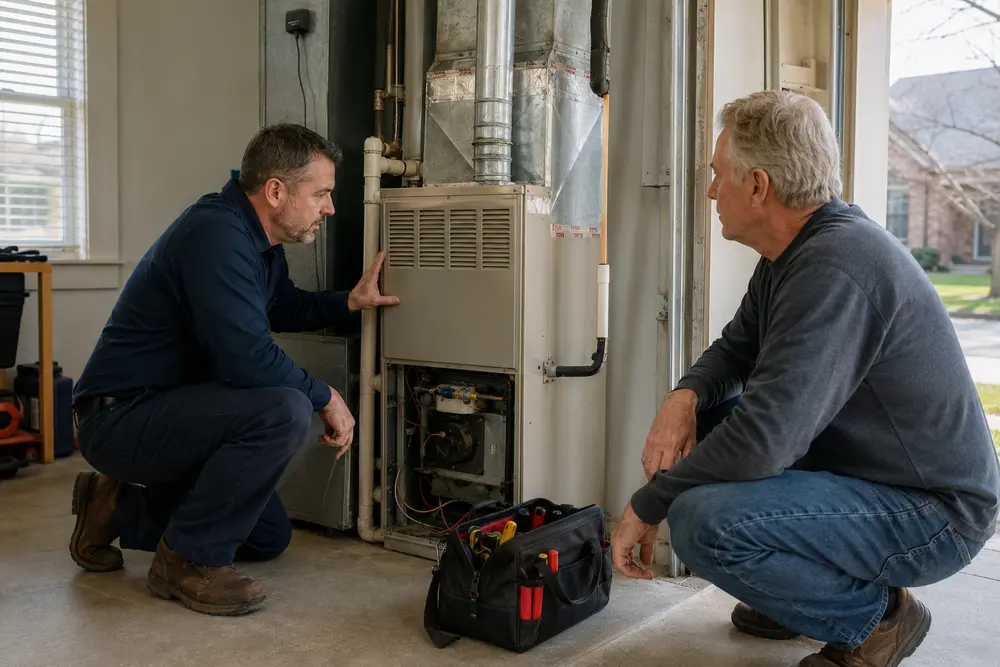
That points away from the thermostat and toward airflow.
A dirty filter can restrict air movement through the furnace or air handler. ENERGY STAR specifically warns that dirty filters increase energy use and can contribute to equipment problems, which is why filter inspection is part of routine HVAC maintenance. [5]
If your filter is designed for homeowner replacement, inspect it.
Also check whether supply registers and major return grilles have been blocked by furniture, rugs, storage or other objects.
Do not compensate for an airflow problem by simply setting the thermostat lower. A lower cooling setpoint does not remove the restriction.
Look at the Pattern, Not Just the Number
The way your home misses the setpoint often provides more useful information than the exact temperature difference.
| What you notice | What it may point toward |
|---|---|
| Thermostat reading seems wrong even when HVAC is off | Thermostat location, sensor or calibration |
| Weak airflow from many vents | Filter, blower, coil or duct airflow issue |
| One room is far off but others are comfortable | Distribution, duct, balancing, solar-load or room-specific issue |
| AC runs constantly but house keeps getting warmer | Cooling capacity, equipment fault or building-load issue |
| Furnace repeatedly starts and stops | Airflow, control, ignition or safety-related issue |
| Problem happens only during extreme weather | System/load/design issue may need evaluation |
| Outdoor equipment is not running when cooling is called | Electrical, control or equipment problem requiring diagnosis |
These are diagnostic clues, not definitive diagnoses.
Several different failures can create the same symptom, which is why replacing the thermostat based on symptoms alone is often premature.
Extreme Oklahoma Weather Can Expose Marginal Problems
Oklahoma HVAC systems can experience high seasonal demand.
As a recent example, the National Weather Service recorded Oklahoma City highs of 102°F on September 7 and 103°F on September 8, 2026, well above the daily normals reported for those dates. [25]
Conditions like that can expose weaknesses that are not obvious during moderate weather.
A dirty coil, restricted filter, duct problem or marginally performing system might appear acceptable on an 85°F day and struggle much more when the heat load rises.
But avoid the common internet shortcut that says every air conditioner can only cool a house a fixed number of degrees below outdoor temperature.
HVAC sizing is more sophisticated than that.
Proper system selection is based on the building's calculated cooling load at design conditions. ENERGY STAR warns against rule-of-thumb equipment sizing, while ACCA identifies Manual J as the residential load-calculation procedure used to determine heating and cooling requirements. [26]
So a home that cannot reach the setpoint during hot weather needs diagnosis, not an automatic assumption that "20 degrees is all an AC can do."
If the Equipment Runs but the Home Does Not Cool, the Problem May Be Beyond the Thermostat
Once you have verified basic thermostat settings, filter condition and unobstructed vents, a persistent problem may require HVAC diagnosis.
When the problem occurs during cooling, professional AC diagnosis can identify equipment and refrigerant-side causes; during heating season, review the available furnace repair options.
Cooling-related possibilities include:
poor airflow,
a dirty heat-transfer surface,
refrigerant-system problems,
blower problems,
electrical or control failures,
duct leakage,
or incorrect system capacity.
For heating, the possibilities change with the equipment type and can include ignition, combustion, heat-pump, airflow, safety-control or electrical problems.
Homeowners should avoid refrigerant handling, opening high-voltage equipment or bypassing furnace safety devices.
If the air conditioner has ice on refrigerant tubing or indoor components, if electrical equipment is overheating, or if a furnace is showing a combustion-related warning, professional evaluation is appropriate.
Could the HVAC System Be the Wrong Size?
Possibly, but do not jump to that conclusion until the system has been checked for actual faults.
If the problem has existed since installation, learning how HVAC load calculations work can clarify whether capacity should be investigated.
An undersized system can struggle to meet the building's load during demanding weather. An oversized system creates a different set of problems because it may satisfy the thermostat too quickly and cycle frequently.
ENERGY STAR specifically notes that oversized equipment can cycle excessively and compromise comfort, while ACCA emphasizes the importance of load calculations rather than replacing old equipment with a new unit based purely on the previous size.
Sizing deserves particular attention when:
the comfort problem has existed since installation,
an addition has changed the house,
major window or insulation changes have been made,
the old equipment was selected by rule of thumb,
or a newly installed system has never performed properly.
A documented load calculation is the right way to evaluate whether the system's capacity matches the home's actual heating and cooling demands.
What Can You Safely Check Before Calling an HVAC Technician?
Use a simple sequence.
First, confirm thermostat mode and setpoint.
Second, check schedules and smart-thermostat features.
Third, inspect the filter if it is homeowner-accessible.
Fourth, make sure vents and returns are not obstructed.
Fifth, see whether the heating or cooling equipment appears to start when the thermostat calls.
Sixth, note the symptoms: weak airflow, unusual sounds, ice, repeated cycling, only one affected room, or a thermostat reading that seems inaccurate.
That information is much more useful to a technician than simply saying, "The thermostat isn't working."
Do not remove equipment covers, adjust gas pressure, handle refrigerant, bypass switches or perform live electrical testing unless you are trained and qualified to do so.
When Should You Call for Professional Diagnosis?
Call when the setpoint problem continues after the basic homeowner checks, especially when the HVAC system is running continuously without improving conditions or repeatedly stopping before the house reaches the target.
When the source is still unclear, the broader whole-home HVAC help page is the best starting point.
Professional evaluation is also warranted when:
the system does not respond to thermostat calls,
airflow has become unusually weak,
the AC is icing,
the furnace is repeatedly shutting itself down,
you smell overheating electrical components,
a carbon monoxide alarm activates,
or the problem began immediately after equipment or thermostat installation.
The thermostat is the control center, but it cannot overcome a mechanical, airflow, duct or sizing problem somewhere else in the system.
Get Clear Guidance for Your Home
If your thermostat settings, filter and vents all look normal but the home still cannot reach the target temperature, an HVAC diagnostic visit can determine whether the problem is the thermostat, airflow, equipment, ductwork or system capacity.
Frequently Asked Questions
Why does my thermostat say 75 when I set it to 72?
The thermostat may be correctly calling for cooling while the HVAC system cannot satisfy the load, or the thermostat itself may be sensing temperature inaccurately because of placement, settings or another control issue.
Should I replace the thermostat if my house will not reach the set temperature?
Not before checking the rest of the system. A dirty filter, airflow restriction, HVAC malfunction, duct issue or capacity problem can all make a correctly functioning thermostat appear to be the culprit.
Can thermostat location affect the temperature?
Yes. Thermostat manufacturers recommend avoiding locations influenced by direct sunlight, drafts, major heat sources and obstructed airflow because these conditions can distort the temperature the thermostat senses. [24]
Why does my AC reach the setpoint at night but not in the afternoon?
Afternoon heat load may be higher because of outdoor temperature and solar gain. A system that only loses ground under peak conditions may need its equipment performance and building load evaluated rather than automatically replacing the thermostat.
Is it normal for an AC to run continuously on an extremely hot Oklahoma day?
Longer operation can occur as outdoor conditions approach the system's design load. Whether continuous operation is normal for a particular home depends on system sizing, actual weather, building load and equipment condition; there is no universal outdoor-versus-indoor temperature rule that diagnoses every system. [29]