
When you schedule a furnace tune-up, what are you actually paying someone to do?
That is an important question because a professional tune-up should be more than turning the furnace on, checking that warm air comes from the vents, and leaving. A useful maintenance visit evaluates how the heating system starts, operates, moves air, burns fuel where applicable, responds to its controls, and shuts down.
ENERGY STAR recommends annual pre-season heating and cooling checkups and specifically suggests scheduling heating-system maintenance in the fall, before contractors enter the busiest part of winter. Its maintenance checklist includes thermostat checks, electrical inspection, system controls, airflow-related components and, for fuel-burning heating systems, gas or oil connections, burner combustion and heat-exchanger inspection. [1]
That timing makes particular sense in Oklahoma, where a mild stretch can be followed by much colder weather. National Weather Service records for the region document winter events involving freezing rain, sleet, snow, significant icing and extended outages. [2]
Here is what Oklahoma City homeowners should expect from a meaningful furnace tune-up, what they can safely do themselves, and which tasks belong with an HVAC professional.
What Is a Furnace Tune-Up?
A furnace tune-up is preventive maintenance designed to evaluate the condition and operation of your heating system before a failure occurs. It is different from a furnace repair because the technician is not necessarily responding to one failed component.
A good maintenance visit is primarily about three questions:
Is the furnace operating safely?
Is it operating as intended?
Are there developing problems that should be addressed before heating demand increases?
ACCA's residential HVAC maintenance framework covers controls, safety devices, furnaces, air-distribution systems and related equipment rather than treating maintenance as a quick equipment-only inspection. [3]
That distinction matters. A furnace can still produce heat while having restricted airflow, dirty burners, an electrical connection problem, an inaccurate thermostat or another condition that deserves attention.
What Does a Furnace Tune-Up Usually Include?
The exact checklist varies by furnace type, manufacturer and contractor, but homeowners should expect a professional visit to address several core areas.
For Oklahoma City homeowners who want this inspection completed before winter, professional furnace maintenance provides the appropriate service path.
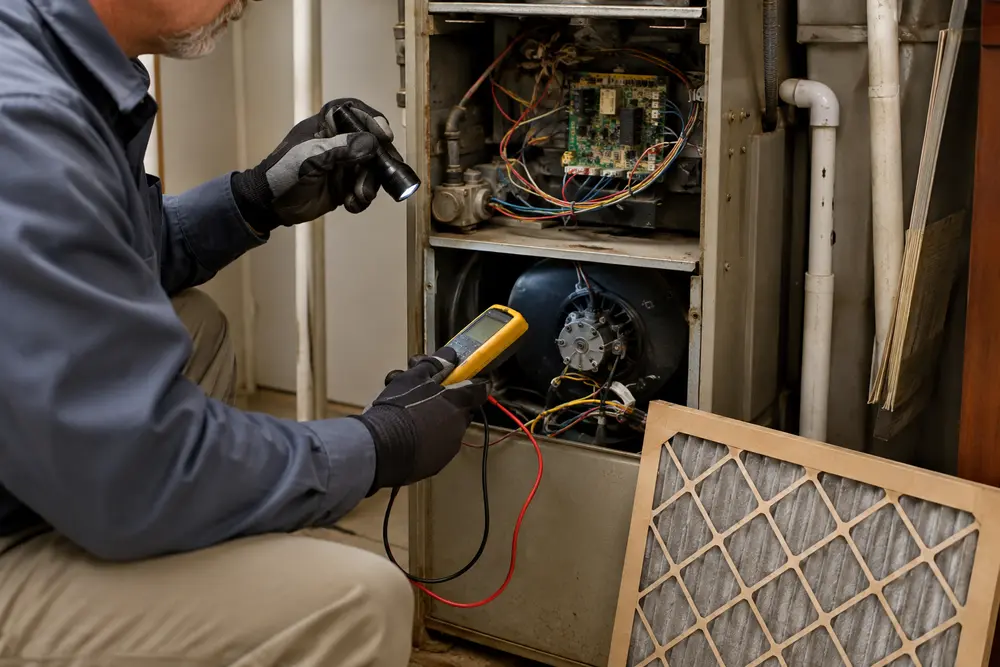
| Tune-up area | What is being evaluated | Why it matters |
|---|---|---|
| Thermostat and controls | Settings, heating call and operating sequence | Confirms the furnace receives and responds to the correct signals |
| Electrical system | Connections and relevant motor electrical readings | Helps identify unsafe or deteriorating connections |
| Airflow | Filter condition, blower operation and obvious restrictions | Adequate airflow is essential for comfort and equipment operation |
| Burners and ignition | Ignition sequence and burner operation on fuel-burning systems | Poor ignition or combustion deserves professional attention |
| Heat exchanger | Condition of the heat exchanger on a combustion furnace | The heat exchanger separates combustion products from household air |
| Safety controls | Startup, operation and shutdown protections | Confirms safety devices are functioning as intended |
| Venting | Flue and combustion venting where applicable | Combustion gases must be vented correctly |
| General condition | Dirt, wear, unusual noise, cycling or deteriorated components | Helps identify developing problems before peak season |
ENERGY STAR specifically calls for checking controls, electrical connections, blower components and heating-specific items such as fuel connections, gas pressure, burner combustion and the heat exchanger. Carrier's maintenance guidance similarly includes ignition components, burners, blower assemblies, wiring, venting, heat exchangers and gas-supply components on applicable systems. [4]
That does not mean every furnace needs the same maintenance procedure. A gas furnace, electric furnace and dual-fuel system have different components. The checklist should match the equipment that is actually installed.
Thermostat and Operating-Sequence Checks Matter More Than They Seem
A heating system is not just a furnace cabinet. The thermostat, electrical controls, blower and safety sequence all have to work together.
During maintenance, the technician should verify that the thermostat calls for heat correctly and that the system starts, operates and shuts down normally. ENERGY STAR specifically includes thermostat settings and operating controls in its recommended maintenance checklist. [5]
This is useful because complaints that sound like furnace problems can sometimes originate elsewhere.
For example, a homeowner may report:
"The furnace runs, but the house never feels warm."
"The thermostat is set to 70, but the room stays at 67."
"It heats for a few minutes and shuts off."
"The furnace starts several times before the house warms up."
Each symptom can have more than one cause. Maintenance gives the technician an opportunity to look at the system as a whole instead of assuming one part is responsible.
Why the Heat Exchanger and Combustion System Deserve Professional Attention
For a gas-fired furnace, combustion-related inspection is one of the reasons furnace maintenance should not be reduced to a DIY cleaning project.
ENERGY STAR's heating-specific maintenance guidance calls for checking fuel connections, gas pressure, burner combustion and the heat exchanger, noting that improperly operating fuel connections and combustion components can create safety problems. [5]
Homeowners should not disassemble burners, adjust gas pressure or attempt to repair a heat exchanger themselves.
If you smell gas, a carbon monoxide alarm activates, or you suspect a combustion problem, treat the situation as a safety matter rather than a maintenance project. Leave the affected area as appropriate and follow the instructions of your gas utility, emergency services and carbon-monoxide-alarm manufacturer.
Routine tune-ups are meant to help identify concerning conditions before they become an emergency. They are not a substitute for immediate action when a safety warning is already present.
What Can a Homeowner Safely Check Before the Appointment?
There are several useful checks that usually do not require opening the furnace or handling gas and electrical components.
For the most common airflow-maintenance question, review how often to change your furnace filter in Oklahoma conditions.
Start with the filter. ENERGY STAR recommends regular filter inspection and replacement or cleaning as appropriate because a dirty filter can restrict airflow and increase strain on HVAC equipment. [5]
Then walk through the house.
Make sure supply registers are open and not hidden behind furniture. Check that large return grilles are unobstructed. Confirm the thermostat is in heating mode and review the schedule if you use a programmable or smart thermostat.
You can also listen to the furnace.
Normal operating sounds vary by equipment, but new rattling, grinding, repeated clicking or unusually frequent starting and stopping are worth mentioning to the technician.
What homeowners generally should not do is adjust gas valves, remove combustion components, bypass a safety switch or attempt electrical troubleshooting inside the furnace cabinet.
A Tune-Up Is Not the Same Thing as a Repair
Maintenance is preventive. Repair is corrective.
A furnace tune-up may uncover a component that needs repair, but the two services should not be presented as though they are automatically the same job.
Suppose the technician discovers a worn electrical component, failed ignition part or damaged safety control. A responsible next step is to explain what was found, why it matters and whether it requires immediate repair or monitoring.
The same principle applies to an older furnace. Maintenance should not automatically become a replacement pitch.
If the equipment is still serviceable, a maintenance visit should help preserve reliable operation. If the inspection uncovers a serious safety problem, repeated failure pattern or major component issue, that information can start a separate repair-versus-replacement discussion.
When Is the Best Time for a Furnace Tune-Up in Oklahoma?
Fall is usually the most practical time.
You can also use this practical guide to prepare your furnace for Oklahoma winter before the first sustained cold period.
ENERGY STAR recommends pre-season maintenance and specifically points to fall for heating systems. [5]
There is also a practical Oklahoma reason: the first genuinely cold stretch is a poor time to discover that the furnace has an ignition, airflow or safety-control problem.
A September or October appointment gives you a chance to:
test the heating system before you depend on it,
address a developing problem while temperatures are still manageable,
replace a dirty filter,
review thermostat settings,
and enter winter knowing the system has been evaluated.
If you missed fall, maintenance can still be worthwhile later. Preventive care does not become useless simply because the heating season has started.
How Can You Tell Whether a Furnace Tune-Up Is Thorough?
Ask what is included before scheduling.
Homeowners who prefer recurring seasonal care can compare an ongoing HVAC maintenance plan with one-time service.
"Furnace tune-up" can be used for very different levels of service. A useful question is not simply, "How many points are on your checklist?" A long checklist can still contain superficial items.
Better questions include:
Will the technician evaluate the heat exchanger and combustion system on a gas furnace?
Will safety controls and the operating sequence be tested?
Will blower and airflow conditions be checked?
Will electrical connections and relevant operating measurements be evaluated?
Will I be told which findings are maintenance items versus actual repairs?
ACCA's quality-maintenance framework emphasizes inspection, testing and measurement across electrical, controls, mechanical, venting, distribution and other applicable system areas. [6]
That is a better standard for evaluating a maintenance visit than simply asking whether someone will "clean the furnace."
What If the Furnace Already Has Problems?
If the furnace is already failing to heat the house, repeatedly shutting down, producing abnormal odors, tripping safety devices or showing another active malfunction, you may need diagnosis and repair rather than routine maintenance.
If you are unsure whether the system needs maintenance or repair, contact Smith Brothers Heat & Air for guidance.
A tune-up is most valuable before a breakdown.
For an Oklahoma homeowner, a practical fall sequence is:
replace or inspect the filter,
test the heating system,
schedule annual maintenance,
and address any unusual operation before the first serious cold spell.
If you are not sure whether your furnace needs routine maintenance or diagnosis of an existing problem, a professional inspection can clarify which type of service is appropriate.
Get Clear Guidance for Your Home
If you want to know whether your heating system is ready for Oklahoma's colder weather, a professional furnace inspection can identify maintenance needs before they become a mid-winter repair.
Frequently Asked Questions
How often should a furnace get a tune-up?
Annual pre-season maintenance is a widely recommended approach. ENERGY STAR recommends annual heating and cooling checkups and suggests scheduling heating maintenance in the fall. [5]
Does a furnace tune-up include the air filter?
Filter condition should be checked as part of overall airflow evaluation, although whether a replacement filter is included depends on the contractor and service agreement. ENERGY STAR identifies regular filter inspection and replacement as an important homeowner maintenance task. [5]
Will a furnace tune-up fix a furnace that is not heating?
Not necessarily. A tune-up is preventive maintenance. If the system has an active failure, it may require diagnostic testing and a separate repair.
Should a furnace be tuned up even if it seems to work normally?
Yes, preventive maintenance is intended to evaluate operation before a failure becomes obvious. Pre-season inspection can uncover airflow, controls, combustion or electrical conditions while the equipment is still operating. [8]
Can I tune up my furnace myself?
Homeowners can generally handle basic tasks such as checking the filter, keeping vents clear and verifying thermostat settings. Combustion, gas, internal electrical and safety-control work should be left to qualified professionals. [5]