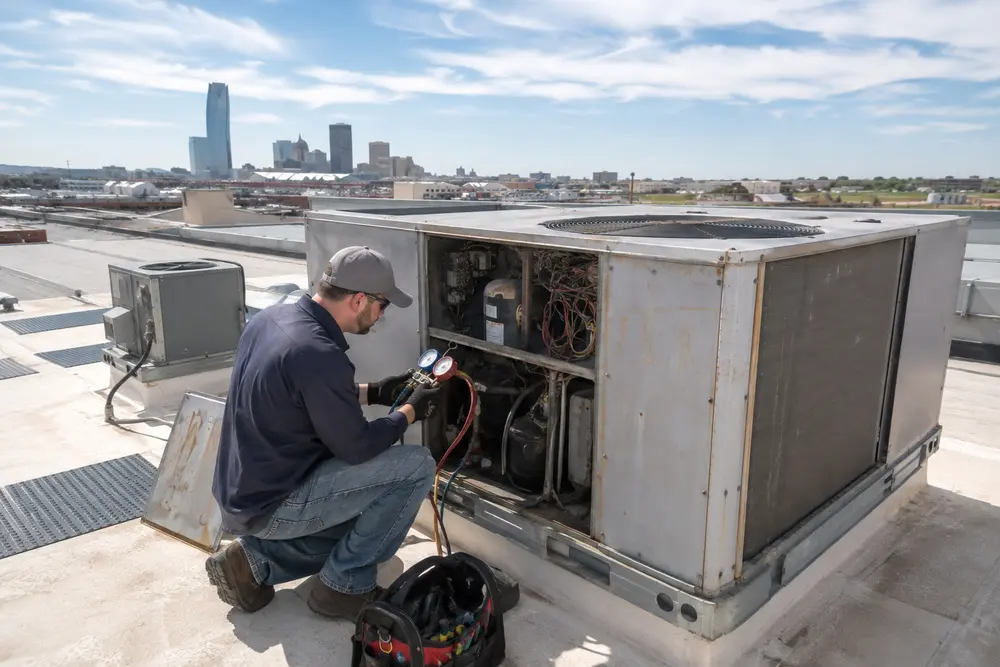
A commercial HVAC system affects more than temperature. It can influence employee comfort, customer experience, tenant complaints, product conditions, operating cost and whether a space can stay open during extreme weather. Waiting for a complete failure can turn an equipment decision into an operational emergency.
That does not mean every older rooftop unit should be replaced. The more useful approach is to build an asset history, inspect current condition and compare the risk of continued repairs with a planned project. This guide shows what Oklahoma property owners, landlords and facility managers should review.
Seven signs replacement should be evaluated
1. Corrective repairs keep returning
Repeated calls on the same unit—or new failures moving from one component to another—are more meaningful than a single breakdown. Review two or three years of service invoices by asset number. Include parts, labour, crane access, after-hours response and temporary cooling or heating.
2. Downtime is disrupting operations
A repair that looks affordable on an invoice may still be expensive if it closes a dining area, creates tenant complaints, interrupts production or forces staff relocation. Assigning an estimated business cost to downtime makes the comparison more realistic.
3. Comfort or humidity complaints persist
Hot and cold zones, stale areas, high humidity and long run times can point to equipment decline, but they can also come from controls, ventilation, duct distribution, envelope changes or altered occupancy. Replacement should follow diagnosis, not substitute for it.
4. Maintenance cost is rising without restoring reliability
Planned maintenance protects useful equipment. It cannot reverse compressor wear, severe corrosion, a compromised heat exchanger or widespread deterioration. If each visit produces another significant finding, it may be time to compare capital replacement.

5. The building use has changed
A former retail space converted to a restaurant, clinic, fitness studio or dense office may have different cooling, ventilation and operating-hour requirements. Additions, interior partitions, new kitchen equipment and increased occupancy can also make the old design unsuitable even when the equipment runs.
6. Controls and equipment no longer work well together
Older units may have limited staging or control capability. Before replacing them, confirm whether sensor, thermostat, scheduling or economizer faults are driving poor performance. If the equipment cannot support the control strategy the property now needs, that limitation belongs in the replacement case.
7. A critical asset has no acceptable failure plan
A unit serving a server room, medical function, food operation or other critical area should be judged partly by consequence. Planned replacement may be justified earlier when a failure would cause a disproportionate loss or when temporary conditioning is difficult.
Repair, retrofit or replace?
| Option | Best fit | Watch for |
|---|---|---|
| Repair | Isolated fault; sound major components; acceptable reliability. | Repeated repairs that only reset the failure cycle. |
| Retrofit | Sound equipment with a clear controls, airflow or accessory opportunity. | Investing in upgrades on an asset near major mechanical failure. |
| Replace | High failure risk, poor fit, major deterioration or strong life-cycle case. | One-for-one replacement without checking loads, curbs, ducts or controls. |
The correct option may differ by unit. A multi-tenant building could replace two critical rooftop units, retrofit controls on three others and continue planned maintenance on the rest. That is why portfolio-level planning is more useful than applying one age cutoff to every asset.
Build a simple HVAC asset inventory
Start with one row per unit. Record the equipment ID, location, serving area, type, capacity, approximate age, refrigerant, condition, control type, repair history, downtime impact and known access constraints. Photographs and model/serial data make future planning faster.
- Rank condition separately from business criticality.
- Flag units with repeated refrigerant loss or major-component risk.
- Track which assets share electrical, duct, curb or control dependencies.
- Group replacements where crane mobilization or shutdown coordination can be shared.
- Update the list after each major service event.
Smith Brothers’ commercial property management HVAC services can support ongoing unit documentation and maintenance planning across Oklahoma City-area properties.
Plan replacement around the business
Planned work gives the owner time to verify equipment lead times, structural or curb requirements, crane access, electrical capacity, gas connections, permits, controls integration and shutdown windows. It also allows occupants and tenants to receive clear notice.
For a new use or major renovation, avoid choosing equipment by the existing nameplate alone. Commercial load calculations account for building construction, occupancy, lighting, ventilation, schedules and internal loads. ACCA identifies Manual N as the commercial load-calculation method; Manual J is for residences.
What a commercial replacement proposal should include
- Existing-condition findings and the reason replacement is recommended.
- Equipment capacity and the basis for selection.
- Demolition, disposal, crane or lift, roof access and curb-adapter scope.
- Duct, electrical, gas, drainage, ventilation and controls work.
- Permit, inspection, startup, testing and commissioning responsibilities.
- Schedule, shutdown assumptions, exclusions and warranty coverage.
Before comparing bids, read the companion guide to commercial HVAC installation cost in Oklahoma. For service planning, explore Smith Brothers’ commercial HVAC capabilities.
Plan commercial HVAC replacement before failure
Document asset condition, prioritize risk and define a replacement scope that fits the building and its operations.
Request a commercial HVAC evaluationFrequently asked questions
How do you know when a commercial HVAC system needs replacement?
Look for a pattern of recurring repairs, growing downtime, persistent comfort or humidity problems, rising operating cost and equipment that no longer matches the building’s use. A field evaluation and life-cycle comparison should confirm the decision.
Should all rooftop units be replaced at once?
Not always. An asset inventory can group units by condition, criticality and remaining risk so replacements can be phased when appropriate.
Can controls or maintenance postpone replacement?
Sometimes. Correcting controls, airflow or deferred maintenance can restore performance when the core equipment remains sound. These measures will not correct failing compressors, damaged heat exchangers or widespread deterioration.