
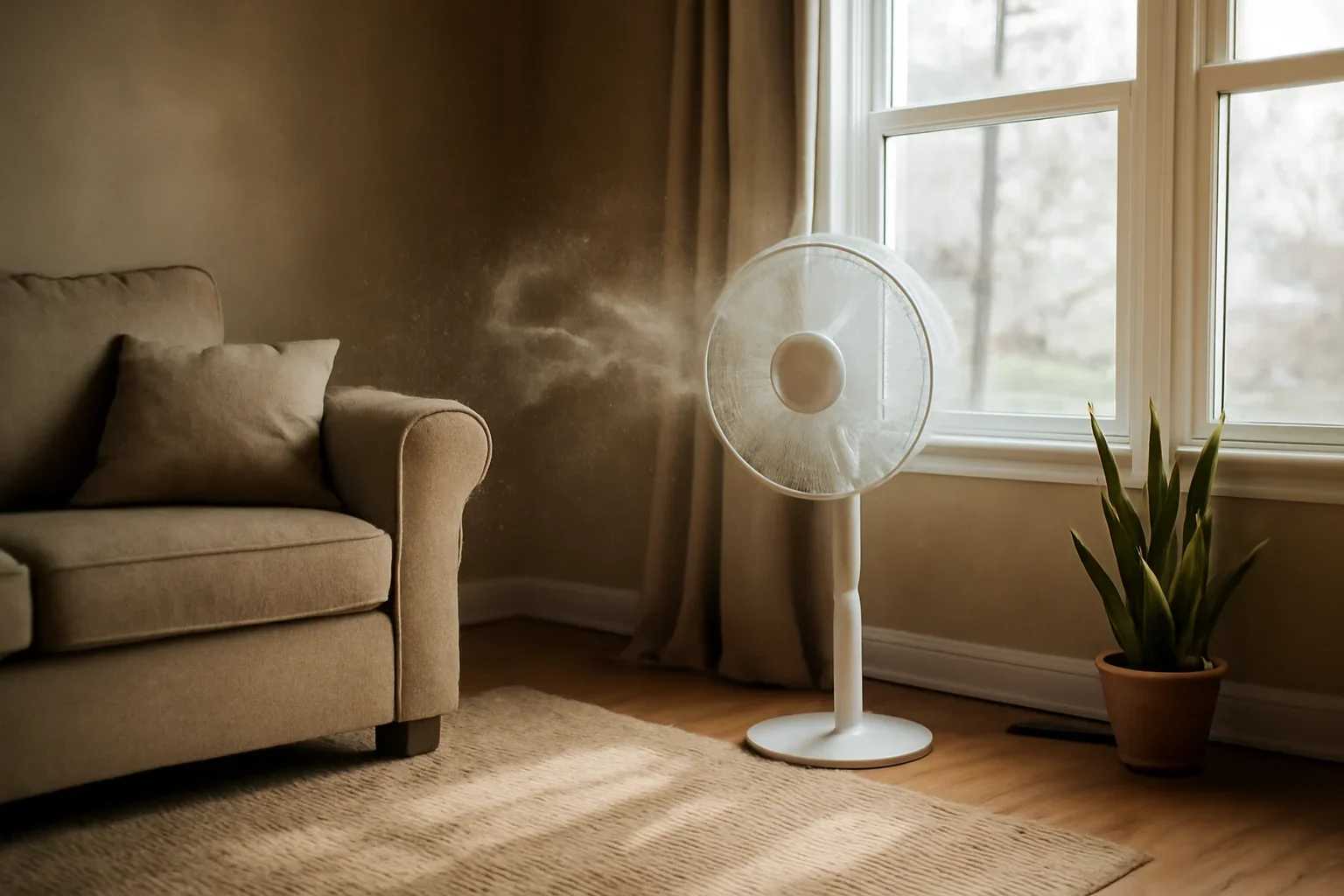
Quick Answer: The biggest causes of poor indoor air quality in OKC homes are weak filtration, poor ventilation, humidity and moisture problems, excess dust and allergens, dirty HVAC equipment, and indoor pollutant sources — including cooking fumes, VOCs, pet dander, combustion byproducts, and attached-garage contamination. In some homes the real issue is not "dirty air" alone but stale air, hidden moisture, or an airflow problem that keeps pollutants trapped indoors.
If your home feels dusty, stuffy, musty, dry, irritating, or just "off," the answer is usually not to buy the first air-quality product you see. The right fix depends on what is actually driving the problem. A house with pet dander and overloaded filters needs a different solution than a house with excess humidity, combustion concerns, or air that feels stale because it is not moving well.
Why Oklahoma City Homes Notice IAQ Problems Quickly
Oklahoma City's climate creates specific conditions that amplify indoor air quality problems. The spring pollen season is long and intense, with high tree and grass pollen counts peaking across April, May, and into June. Windblown dust from the surrounding plains is a near-constant factor — Oklahoma regularly ranks among the dustiest states in the country for fine particulate matter.
The long air conditioning season, which often runs from late April through October, means homes stay sealed for months. Natural ventilation through open windows — which dilutes indoor pollutants and refreshes stale air — is largely unavailable during those months. Everything that builds up indoors stays indoors until the system removes it or a window finally opens in autumn.
Summer humidity adds moisture pressure the HVAC system has to manage. If the system is oversized, it short-cycles — cooling the air temperature quickly but shutting off before completing full dehumidification runs. Homes with this problem feel clammy at a comfortable thermostat reading. Winter brings the opposite: long gas-furnace heating runs drive indoor relative humidity low enough to cause persistent throat and skin irritation that homeowners often attribute to illness rather than air quality.
That also means "my house is dusty" and "my house feels stale" are not the same complaint. Dust points more toward particles, filtration, leakage, and housekeeping load. Stale air points more toward ventilation, odours, airflow balance, and humidity. Getting the diagnosis right is the first step.
The Most Common Causes of Poor Indoor Air Quality

Indoor air quality problems are easier to solve when the cause is identified first, rather than jumping straight to equipment.
1. Weak filtration or the wrong filter
The HVAC filter is the primary line of defence against airborne particles. A clogged filter, a low-performing filter, or one that is not the right fit for the system all allow fine particles to keep recirculating every time the blower runs. In some homes the filter loads quickly because the house is genuinely dusty. In others, the filter is changed regularly but the air still feels bad because the real problem is humidity, duct leakage, or a source the filter cannot address.
One important nuance homeowners often miss: a stronger filter is not automatically better. A filter that is more restrictive than the system can handle reduces airflow and creates its own comfort and efficiency problems. Good filtration has to match both the home's particle load and the equipment's airflow design.
2. Ventilation problems and stale indoor air
Some homes do not bring in enough fresh outdoor air or do not exhaust indoor pollutants effectively. That can leave bedrooms stuffy in the morning, make odours linger, and let cooking fumes, moisture, and everyday contaminants build up. This is especially noticeable in tighter homes or in homes that stay closed up for long stretches — which describes most OKC homes for most of the year.
3. Humidity imbalance and moisture problems
Too much moisture can make air feel muggy and stale, encourage mould growth in damp corners, and cause musty odours that persist even after cleaning. Too little humidity — common during Oklahoma's long heating season — causes skin and throat irritation, worsens allergy and asthma symptoms, and contributes to static electricity and wood shrinkage. If humidity is part of the problem, adding a purifier alone will not change how the house feels.
4. Dust, pollen, pet dander, and fine particles
These are the most visible complaints. Dust that returns quickly after cleaning, allergy flare-ups indoors, and debris around registers or furniture often point to a particle problem — but the real source varies. Pets, poor duct sealing, frequent foot traffic, remodelling dust, overloaded filters, or return-side duct leakage that pulls in attic or crawlspace air can all contribute. Identifying the source determines whether the fix is a better filter, tighter ducts, or source control.
5. VOCs from cleaners, fragrances, paints, and remodelling materials
Not every air-quality complaint is particle-related. Strong cleaners, air fresheners, new flooring, paint, adhesives, candles, and some hobby or garage products all introduce volatile organic compounds (VOCs) into the living space. These are invisible but can cause eye, nose, and throat irritation that homeowners often attribute to dust or pollen. A whole-home filter helps with particles — it does not solve every odour or gas-phase issue by itself.
6. Combustion byproducts from appliances, fireplaces, or attached garages
Fuel-burning appliances can affect indoor air in ways homeowners do not always notice right away. Furnaces, gas stoves, fireplaces, space heaters, and vehicles in attached garages can introduce pollutants or safety concerns if venting is compromised. Lingering combustion odours, headaches around appliance use, or symptoms tied to gas equipment deserve more than a casual filter swap — they deserve professional evaluation.
7. Dirty HVAC equipment, duct leakage, and airflow imbalance
Sometimes the home is not generating unusually dirty air — the system is just doing a poor job moving and managing it. Dirty blower components, weak return airflow, duct leakage, blocked vents, and pressure imbalances can all make rooms feel stale, uneven, dusty, or humid. That is why indoor air quality and airflow often need to be evaluated together rather than treated as separate problems.
Hidden Causes Homeowners Often Miss
Less obvious sources worth checking
- Radon — a colourless, odourless gas that cannot be detected without a test kit. Oklahoma has areas with elevated radon levels and it is worth testing if you have not done so.
- Moisture behind walls or around equipment — a musty smell may show up well before visible mould does.
- Return-side duct leakage — the system may be pulling unfiltered air in from attic, crawlspace, or wall cavities rather than from living areas.
- Attached-garage contamination — exhaust fumes, stored chemicals, and paint can migrate through gaps into the living space.
- One-room symptoms — if only one area consistently feels bad, the cause may be local airflow, insulation, moisture, or a source in that specific space rather than a whole-home filtration issue.
Not every indoor air quality problem is solved by the same purifier, filter, or add-on. A balanced diagnosis matters.
Signs Your Indoor Air Quality Is Poor
- Dust returns fast after cleaning
- Rooms feel stale even when the temperature is comfortable
- Musty or sour odours appear when the system runs
- Allergy or irritation symptoms are worse indoors than outside
- Air feels clammy even at the right thermostat setting
- Air feels dry and irritating through the heating season
- Filters clog unusually quickly
- Cooking smells, pet odours, or garage fumes linger too long
- One or two rooms consistently feel worse than the rest of the house
- Headaches or throat irritation improve when you leave the home
Symptom-to-Cause Table: What to Check First
| What You Notice | Most Likely Cause | What to Check First |
|---|---|---|
| Dust builds up quickly | Filtration weakness, duct leakage, outdoor dust, pets, or remodelling debris | Filter condition, return airflow, recent dust sources, and duct or register issues |
| House feels musty | Excess humidity, moisture in ducts or air handler, or mould-friendly conditions | Bathrooms, closets, attic/utility spaces, condensate drainage, and humidity levels |
| Bedrooms stuffy in the morning | Stale air, weak ventilation, or poor airflow balance | Supply and return performance, room airflow, overnight pollutant buildup |
| Allergies worse indoors | Pollen, pet dander, dust mites, mould spores, or weak filtration | Filter schedule, pet access, soft surfaces, humidity, symptoms away from home |
| Air dry and irritating in winter | Low indoor humidity from extended heating without humidification | Indoor relative humidity reading; consider whole-home humidifier |
| Chemical or fragrance smell lingers | VOCs from cleaning products, paint, new flooring, candles, or renovation materials | Recent products used, enclosed rooms, and whether source control is possible first |
| Combustion smell or headaches near appliances | Combustion byproducts from furnace, stove, fireplace, or attached garage | Appliance venting, CO detector, professional safety inspection |
| Air still bad after filter changes | Ventilation gap, humidity, duct leakage, dirty equipment, or a non-particle source | System airflow, moisture clues, odours, and whether the issue is whole-home or room-specific |
| One room always feels worse | Local airflow problem, duct issue, insulation gap, or a source in that specific space | Supply and return balance in that room; check for local moisture or pollutant sources |
What Oklahoma City Homeowners Should Do First
- Describe the symptom accurately. Dusty, stale, musty, dry, smoky, and humid are not the same problem and do not have the same fix.
- Check the filter and replacement habits. Make sure the filter is clean, properly installed, and appropriate for the system — not just whatever was on the shelf.
- Look for moisture clues. Condensation on windows, damp smells in closets or utility rooms, and slow-drying bathrooms all point toward a humidity issue.
- Think about source changes. New cleaners, paint, pets, candles, remodelling, a new vehicle in the garage, or smoking can all change indoor air quality fast.
- Notice where the complaint is strongest. Whole-home problems and one-room problems often have very different causes and solutions.
- Do not assume one product fixes everything. A purifier helps specific problems. It does not replace ventilation, moisture control, or proper HVAC performance.
What an Air Purifier Helps With — and What It Does Not
An air purifier can be genuinely useful when the main issue is airborne particles — dust, pollen, dander, mould spores. Some products also address certain odour concerns and biological contaminants like bacteria and viruses. For those problems, whole-home purification is a meaningful upgrade over standard filtration alone.
But homeowners are frequently disappointed when they buy a purifier for a house that really has a moisture issue, an airflow problem, a return-side duct leak, or a combustion-related concern. The purifier runs, the air still feels wrong, and the real cause goes unaddressed.
The better question is not "Do I need an air purifier?" It is "What is actually causing the air to feel bad in this home?" Once that answer is clear, the right solution — whether it is filtration, humidity control, ventilation, source control, or professional HVAC service — becomes obvious.

Good indoor air quality work starts with matching the fix to the actual cause — not the other way around.
When It Makes Sense to Call a Professional
Some indoor air quality problems are straightforward DIY fixes — change the filter, open a window, stop burning scented candles. Others need a closer look. Call for a professional evaluation when:
- Filters load unusually fast despite regular replacement
- Dust or odours return immediately after cleaning
- Some rooms stay consistently stuffy or uneven
- Humidity feels wrong even when the system is running
- Musty smells come from vents or utility spaces
- You suspect a combustion, venting, or safety issue
- The problem persists after filter changes and obvious source control
If you suspect radon, that requires a proper test kit or professional testing — not guesswork. If combustion safety is a concern, that deserves prompt professional attention rather than monitoring to see if it gets better.
Smith Brothers Heat & Air has served Oklahoma City-area homeowners since 1999, covering Oklahoma City, Edmond, Norman, Moore, Yukon, Midwest City, Mustang, Nichols Hills, Del City, The Village, and Bethany.
Frequently Asked Questions
What are the most common causes of poor indoor air quality in Oklahoma City?
The most common causes in OKC homes are weak filtration that lets dust and allergens recirculate, humidity imbalance from Oklahoma's humid summers and dry winters, ventilation gaps that leave air stale in sealed homes, dirty HVAC components, and indoor pollutant sources like pet dander, cooking fumes, and VOCs. These causes usually stack together rather than appearing one at a time.
Can HVAC problems cause bad indoor air quality?
Yes. Weak airflow, overloaded filters, dirty blower components, duct leakage, and poor distribution can all make indoor air quality worse or make a healthy home feel stuffy and dusty. The HVAC system is the main vehicle through which indoor air problems spread or get addressed — which is why airflow and air quality are best evaluated together.
Why does my house feel stale even when it is cool?
Temperature control and air quality are not the same thing. A cool home can still have stale air if ventilation is weak, indoor pollutants are not being exhausted, or room-to-room airflow is unbalanced. This is common in OKC homes that stay sealed during the long cooling season.
Will changing the filter fix poor indoor air quality?
Sometimes, but not always. Filter replacement helps when the problem is particle load or restricted airflow. It will not solve every odour, moisture, combustion, or ventilation issue. Describing what the air actually feels like helps identify whether filtration is the right starting point or whether something else needs addressing first.
Does Oklahoma City's climate make indoor air quality worse?
Yes, in specific ways. OKC's high spring pollen counts, windblown plains dust, long cooling seasons that keep homes sealed for months, oversized systems that short-cycle through summer humidity, and dry winter heating air all create distinct IAQ pressures that national guidelines do not fully account for.
Is poor indoor air quality always visible?
No. Many of the most common complaints show up as odours, eye or throat irritation, humidity discomfort, or rooms that just feel stale — not as visible dust. VOCs are invisible. Radon cannot be seen or smelled and requires dedicated testing to detect.
Can Smith Brothers help identify the cause in my OKC home?
Yes. Describing what the air actually feels like — dusty, musty, dry, stale, irritating, or uneven from room to room — gives us a useful starting point for narrowing down whether filtration, purification, humidity control, airflow correction, or a broader HVAC inspection is the right next step.
Need a Local Answer for Your Own Home?
Tell us what the air feels like — dusty, musty, stale, dry, irritating, or uneven from room to room. That helps us narrow down whether the right next step is filtration, purification, humidity control, airflow correction, or a broader HVAC inspection.
Smith Brothers Heat & Air — family-owned, serving Oklahoma City since 1999.
Go to Indoor Air Quality PageHelpful Next Steps
- Indoor Air Quality — overview of the solutions Smith Brothers offers for filtration, purification, humidity control, and ventilation.
- Air Purifier Installation — how whole-home air purifiers address biological contaminants, VOCs, and persistent odours.
- Air Filtration — how the right filtration setup reduces dust, allergens, and airborne particles without restricting airflow.
- Contact Us — describe your air quality concern and we will point you toward the right next step.